
On July 14, 2025 the National Weather Service issued a flash flood warning for Linden. The City of Linden described the storm as causing major flooding and damage to homes and vehicles in residential areas.
Key takeaways
- The July 14, 2025 flash flood warning and the city's description of major flooding show that Linden floods from heavy rain, not only from tides.
- Flooding in that storm was reported on Dewitt Terrace, Elizabeth Avenue and Wood Avenue.
- Floodwater is treated as contaminated, so porous materials that were soaked usually come out.
- Extraction comes first, then cleaning and drying of the structure with air movers and dehumidifiers.
- Photos, lists and moisture readings support insurance and recovery decisions.
What happened in Linden in July 2025
The National Weather Service issued a flash flood warning for Linden on July 14, 2025. The City of Linden later described the rain storm as causing major flooding and damage to homes and vehicles in residential areas.
Flooding in that storm was reported on Dewitt Terrace, Elizabeth Avenue and Wood Avenue. Those reports show how quickly ordinary streets can turn into water.
A storm like that is a flash flood. Water arrives faster than the ground and the storm drains can take it, and it does not need a river to overflow.
Linden was also hit hard in October 2012 by Hurricane Sandy, when Tremley Point was especially storm ravaged. Local news reported a 15 foot tidal surge over Tremley Point homes, and the state reported 20 to 30 homes damaged there.
That history is a reminder that Linden floods in more than one way: from the sky, from the Rahway River and from the Arthur Kill.
Why Linden floods so easily
Linden has a mix of residential, commercial and industrial land and a large share of hard surface. High impervious cover from houses, roads and sidewalks means even small rain events create heavy runoff.
The city is also low and tidal. Linden is exposed to coastal flooding from the Arthur Kill on its east side and to inland flooding along the Rahway River and its tributaries.
When tides are normal or elevated, runoff cannot drain fast enough, which adds to nuisance flooding. Heavy rain at the wrong tide can make the problem worse.
Tremley Point and the creeks
Tremley Point, a low community of about 275 homes at the head of Marshes Creek, sits in the 100 year floodplain of the Rahway River and floods during normal rain events.
Morses Creek is monitored by the state at West Stimson Street in Linden. These waterways add to the places where a hard rain can produce a flood.
The first steps in a flooded Linden home
After a flash flood, the home may still have water in it, and conditions can change. Safety comes first.
If the water has already gone down, treat the house as if it is still unsafe until the power is off and the structure has been checked. Floors that were underwater can be slick with silt, and a soaked ceiling can come down.
- Do not enter a flooded space where outlets, appliances or a furnace could be energized.
- Shut off power at the panel from a dry spot, or have an electrician do it.
- Avoid floodwater. It can carry sewage, fuel and debris.
- Take photos of the water mark, damaged items and the exterior.
- Move vehicles and valuables to higher ground when that is safe.
- Call a restoration team before starting demolition.
How extraction and cleaning work
Once the space is safe, the storm flood cleanup crew starts with the bulk water. Pumps and truck-mounted equipment remove standing water, and wand tools pull water out of carpet.
Mud and silt are removed while still wet. Surfaces that touched floodwater are cleaned and treated, because that water is not clean.
The water extraction page for Linden explains the order of work: pump, extract, clean and then dry.
Water pushed into a house by a flash flood often brings mud with it. Cleaning that mud while it is wet is much easier than scraping it after it dries into carpet and the base of walls.
- Standing water pumped and extracted
- Mud and silt cleared from floors and low walls
- Soaked carpet, pad and insulation removed
- Surfaces cleaned and treated
- Drying equipment placed and readings logged
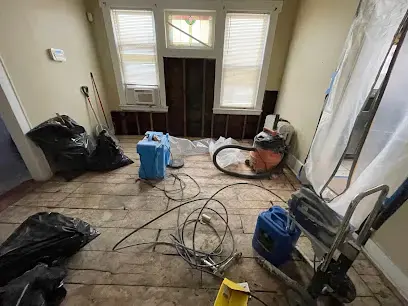
Drying a Linden home that took in floodwater
Humid air near the Arthur Kill and the volume of water in a flood mean drying and moisture checks matter. Walls, subfloors and framing hold water long after the surface looks fine.
The restoration team sets air movers and dehumidifiers and returns to take readings. Materials that cannot be dried, such as saturated drywall and insulation, are cut out and bagged.
For a larger loss the storm flood cleanup page shows how scope moves the price. A garage or crawl space is a smaller job than a basement and first floor that both took water.
A homeowner should also think about the garage, the crawl space or the utility area, where a water heater or furnace may have been standing in water. Those appliances need an inspection before they are turned back on.
Documenting the damage
A flash flood often damages vehicles as well as homes. Records help with each claim.
If the home is in a shared building, tell the other owners or tenants and the manager. A flood does not stop at one front door.
- Photos and video of the water mark before cleanup
- A list of damaged contents, with approximate dates and values
- Moisture readings from the restoration team
- Notes on which streets and neighbors were affected
- Copies of any notices from the City of Linden
Preparing for the next heavy storm
Linden has put money into reducing flooding. A flood mitigation and restoration project for Marshes Creek of over $2 million was awarded to Rutgers University and the City of Linden after Hurricane Sandy.
The project built rain gardens, rain barrels, conveyance improvements, wetland restoration and two porous parking lots that drain through a gravel layer. The NJDEP Blue Acres program also bought flood prone properties in Tremley Point and restored floodplain.
Those efforts help, but a homeowner still needs a plan. Know where the main shutoff and the electrical panel are, and keep valuables off the floor.
The City of Linden's stormwater ordinance requires stormwater management using green infrastructure for flood control and groundwater recharge. For a homeowner, that means a yard that soaks up water instead of shedding it may help.
Gutters that discharge away from the foundation, window wells with covers and a sump pump with backup power are practical steps. None of them stop a flash flood, but they reduce how much water gets in.
Questions
What happened in Linden on July 14, 2025?
The National Weather Service issued a flash flood warning, and the City of Linden described major flooding and damage to homes and vehicles in residential areas.
Which streets flooded in the July 2025 storm?
Flooding was reported on Dewitt Terrace, Elizabeth Avenue and Wood Avenue.
Is floodwater different from a pipe leak?
Yes. Floodwater can carry sewage, fuel and debris, so soaked porous materials are usually removed and surfaces are cleaned and treated.
Why does Linden flood in ordinary rain?
High impervious cover creates heavy runoff, and runoff cannot drain fast enough during normal or elevated tides, which adds to nuisance flooding.